Negotiation: Aggressive And The Other Kind
The art of negotiation is very prevalent throughout the Star Wars saga and is well put on display in some of its most iconic scenes. Past all the blaster marks, laser swords, and Ewok cuteness, most of Star Wars is people talking with each other to sort out their relationships, feuds, and disagreements, and figure out what to do next.
AS Chad Austin explains in his chapter “Hello there: The art of negotiation in Star Wars” in Episode I of Star Wars and Conflict Resolution, there are two main approaches to negotiation that we use to get what we want: the distributive approach and the integrative approach.
The distributive approach is the more popularly perceived form of negotiation, where parties bargain over a fixed amount of assets. A good of how this plays out is the negotiation for the cost of passage on a ship between Han, Luke, and Ben Kenobi. With transport on the said piece of junk called the Millennium Falcon in the balance, the three began engaged in a fairly competitive negotiation, at first. Consider their tactics: parties freely stretched facts (Han rounded down, once again, to claim that the Falcon did the Kessel Run in less than twelve parsecs, and Luke promoted himself from a fairly skilled crop-duster to the potential pilot of an interstellar vessel…). Han made an extreme demand of ten thousand credits for passage in hopes of seeking the best benefit of the bargain. “It’s not personal…it’s strictly business” is the mentality that Han takes in this negotiation leaving out any sort of established relationship between the parties (or so he may think). He tried to get the highest price possible, and Luke tried to lower his expectations, shame him into lowering his offer, and use the power of walking away to get Han to blink and regret his shameless ask. These are all examples of distributive bargaining tactics.
The integrative approach to negotiation tries to get parties past the idea that the value under discussion is fixed and unalterable. Integrative negotiators seek to expand the pie and create a more collaborative environment. Expanding the pie means adding other sources of value to the negotiation in the hopes that each party will be able to get things that they value more than the other does. Ben Kenobi demonstrates this approach in the cantina. [Actually, he demonstrates it twice! The first inciident, is when he tries to defuse the situation with Ponda Baba and Dr. Cornelius Evazan by offering to buy drinks. But he expands the pie more successfully the second time around, when] Ben countered Han’s asking price of 10,000 credits by offering more, and by adding time into the equation. Essentially, he told Han, “Instead of dividing 10,000 credits between us somehow through haggling, let’s divide two resources: 17,000 credits, and a couple of days’ time. Han was happy to give Ben the time, and take the credits. Ben was happy to have the delay, and to give Han the credits. Money meant little to him, provided he was able to pay it on Alderaan, using Bail and Breha’s purse. Not to mention, a couple of extra days on the road would give him some time to condense 10 years in the Jedi Academy into some little tidbits for Luke, and who knows? Maybe he could earn some of that money back by hustling Chewie at djarik.
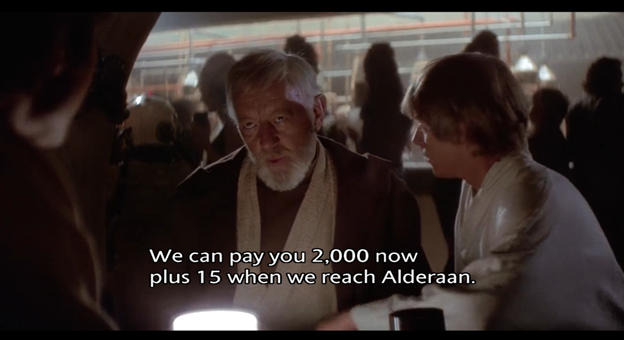
Luke, Ben and Han negotiating in the cantina
The integrative approach requires a level of understanding for the other party’s needs and interests. Perhaps Ben had heard about Han’s issues with Jabba and knew that he’d be happy to take a quick trip off Tatooine and deposit a chunk of credits into his debtor’s account before said debtor turned him into rancor poodoo…
Of course, it’s not always easy to take an integrative approach with a counterpart who insists on sticking with a distributive approach. In the Star Wars universe, the Sith employ - embody, even - a radically competitive approach to negotiation and resolving disputes, an approach that can be summarized as “what’s mine is mine, and what’s yours is mine too”. Two chapters in Star Wars and Conflict Resolution: Episode II are dedicated to figuring out the Sith approach to negotiation and conflict and how one might go about countering it: “Negotiating Like a Sith” by Troy Stearns and “Join Us or Die: Absolutism in Conflict” by Alon Burstein. Worth reading, particularly if your next negotiation is with Darth Maul or someone who reminds you of him…
